Naturalistic landscape design is the art of shaping outdoor spaces so they feel as though nature herself had a hand in the arrangement. Rather than imposing rigid geometry on the land, this approach works with the textures, rhythms, and species that already belong to a place. In Northeast Florida, where salt air meets maritime forest and sandy soils run deep, naturalistic design is not just aesthetically beautiful. It is one of the most intelligent ways to create a landscape that thrives.
For homeowners on Amelia Island, in Jacksonville, and across Nassau and Duval counties, naturalistic landscaping offers a compelling alternative to the high-maintenance, irrigation-heavy yards that dominate so many subdivisions. It is a philosophy that honors what grows well here and arranges it with the eye of an artist.
The Core Principles of Naturalistic Design
Naturalistic landscape design draws from the ecology of a region to create compositions that look effortless but are, in fact, carefully considered. Every plant is chosen for how it relates to its neighbors, to the soil, and to the light patterns of the site. The goal is not wilderness. It is a curated expression of the natural world.
Several principles define this approach:
- Plant communities over specimen planting. Rather than dotting individual plants across a bed, naturalistic design groups species that naturally grow together, creating dense, layered compositions that support one another.
- Seasonal rhythm. The garden changes through the year. Spring wildflowers give way to summer grasses, fall seed heads catch the light, and winter structure holds the composition together.
- Ecological function. Plants are selected not only for beauty but for the roles they play: attracting pollinators, stabilizing soil, providing food and shelter for birds and butterflies.
- Reduced inputs. Once established, a naturalistic landscape requires less irrigation, less fertilizer, and less intervention than a conventional ornamental garden.
The Northeast Florida Native Plant Palette
The success of naturalistic design hinges on choosing the right plants, and Northeast Florida offers a remarkably rich palette. These are species adapted to our sandy soils, humid summers, salt exposure near the coast, and the occasional hard freeze that defines USDA Zone 9a.
Grasses and Groundcovers
- Muhly grass (Muhlenbergia capillaris) produces ethereal pink plumes in autumn and thrives in full sun on sandy, well-drained soil. It is one of the signature plants of naturalistic design in our region.
- Fakahatchee grass (Tripsacum dactyloides) forms graceful, arching clumps and tolerates both dry and seasonally wet conditions.
- Sunshine mimosa (Mimosa strigillosa) is a low-growing, nitrogen-fixing groundcover with small pink flowers. It handles foot traffic and thrives in sandy soils.
- Beach sunflower (Helianthus debilis) spreads quickly along coastal sites, offering bright yellow blooms and excellent salt tolerance.
Shrubs and Mid-Layer Plants
- Beautyberry (Callicarpa americana) is grown for its vivid magenta fruit clusters in fall, a striking accent in naturalistic plantings and a vital food source for migrating birds.
- Firebush (Hamelia patens) blooms prolifically from spring through fall with tubular red-orange flowers that draw hummingbirds and butterflies.
- Coontie (Zamia integrifolia) is Florida's only native cycad, providing evergreen texture in shade or sun and serving as the sole larval host for the rare atala butterfly.
- Saw palmetto (Serenoa repens) adds dramatic, fan-shaped structure and tolerates the most challenging conditions: drought, salt, poor soil, and neglect.
- Walter's viburnum (Viburnum obovatum) offers dense evergreen foliage, spring flowers, and dark berries for wildlife, and it shears well if structure is needed.
Canopy and Accent Trees
- Live oak (Quercus virginiana) is the defining tree of Northeast Florida's landscape, with spreading canopy and extraordinary wind resistance.
- Dahoon holly (Ilex cassine) provides year-round green and bright red berries in winter, tolerating wet soils that many other trees cannot.
- Southern red cedar (Juniperus virginiana var. silicicola) thrives on sandy dunes and coastal sites, offering dense, columnar structure and a distinctive silvery color.
Climate and Soil Considerations for Zone 9a
Northeast Florida sits in USDA Hardiness Zone 9a, where winter lows occasionally dip to 20-25 degrees Fahrenheit. This eliminates some tropical species that thrive further south while allowing a broader palette of temperate plants that need a chill period. It is a sweet spot for diversity.
The soil across much of Nassau and Duval counties is deep, acidic sand with low organic matter and rapid drainage. This is both a challenge and an advantage. Sandy soils warm quickly in spring, drain well during our summer deluges, and suit the many native species that evolved in exactly these conditions. The key is resisting the urge to amend sandy soil into something it is not. Instead, choose plants that love sand.
For properties on Amelia Island and along the coast, salt tolerance is a critical consideration. Wind-driven salt spray can burn the foliage of plants not adapted to coastal conditions. Our native plant palette includes many species that handle salt exposure with grace, including saw palmetto, beach sunflower, muhly grass, and southern red cedar.
Naturalistic vs Traditional Landscaping
The difference between naturalistic and traditional landscaping is not simply a matter of plant selection. It is a fundamentally different relationship with the land.
| Factor | Traditional Landscaping | Naturalistic Design |
|---|---|---|
| Plant selection | Ornamental cultivars, often non-native | Native and regionally adapted species |
| Layout | Formal, symmetrical, geometric beds | Organic, flowing, layered compositions |
| Irrigation | Regular irrigation required | Minimal after establishment (12-18 months) |
| Maintenance | Weekly mowing, edging, pruning, fertilizing | Seasonal cleanup, minimal pruning |
| Wildlife value | Limited habitat for native species | Supports pollinators, birds, beneficial insects |
| Seasonal interest | Often peaks once per year | Evolves through all four seasons |
| Water usage | High (often 50%+ of residential water use) | Low after establishment |
Traditional landscaping is not wrong. Many homeowners love the tidy precision of clipped hedges and annual color beds. But for those drawn to something more organic, something that connects their property to the larger ecology of Northeast Florida, naturalistic design offers a deeply satisfying alternative.
How 3D Design Helps Visualize Naturalistic Landscapes
One of the challenges of naturalistic design is that it can be difficult to visualize before it is planted. Unlike a formal garden where hedges form clear lines and beds follow predictable shapes, naturalistic compositions depend on the interplay of textures, heights, and densities that only become apparent once mature.
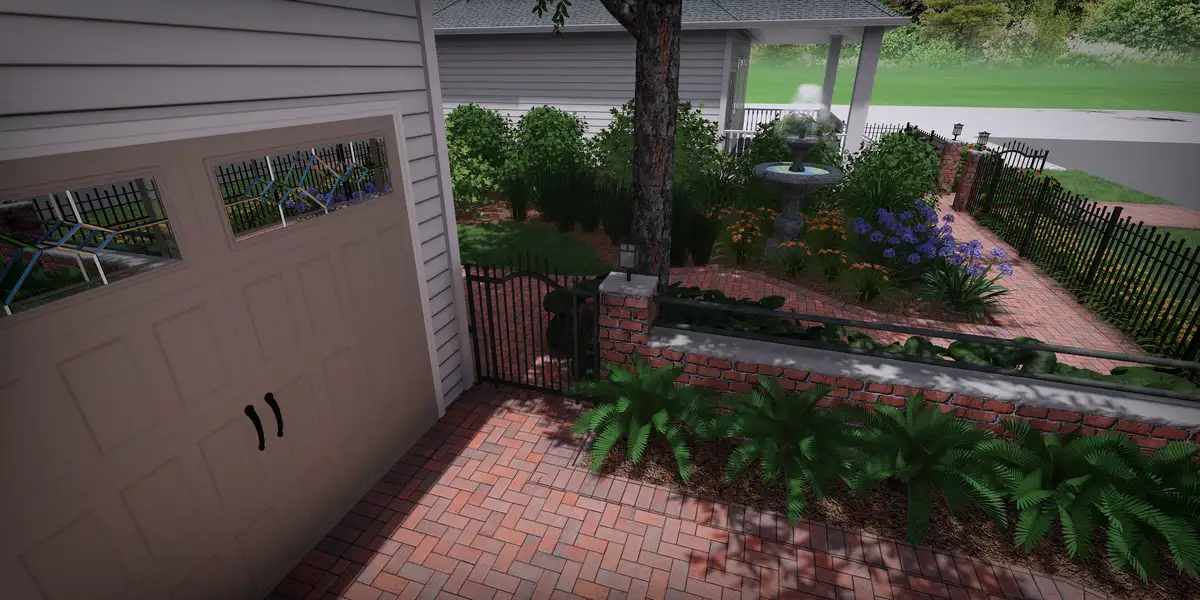
This is where 3D landscape design becomes invaluable. At Bloom and Stone, we create detailed three-dimensional renderings of every project, allowing you to see how native grasses will sway against a backdrop of saw palmettos, how a stone pathway will curve through a planting of muhly grass and beautyberry, or how the canopy of a live oak will filter light across a naturalistic garden below.
3D design also helps with plant spacing. Naturalistic landscapes need to be planted more densely than conventional beds to achieve that "grown together" look. Our renderings show the planting at installation, then illustrate how the garden can mature through its first year, third year, and established form.
Benefits of Naturalistic Landscape Design
The practical advantages of naturalistic landscaping are as compelling as its beauty:
- Lower maintenance costs. Once established, naturalistic landscapes require significantly less mowing, trimming, and chemical inputs. Many homeowners see their monthly landscape maintenance costs drop by 40-60%.
- Water conservation. Native plants adapted to Northeast Florida's rainfall patterns need little to no supplemental irrigation after their first year. In a region where water restrictions are increasingly common, this is a practical advantage.
- Wildlife habitat. A naturalistic garden becomes a living ecosystem. Pollinators work the firebush and beach sunflower. Songbirds nest in the viburnum. Butterflies lay eggs on the coontie. The landscape becomes part of the larger ecological web.
- Resilience. Native plants are adapted to local pests, diseases, and weather extremes. They handle drought, flood, and freeze far better than exotic ornamentals because they evolved here.
- Property value. Well-designed naturalistic landscapes are increasingly sought after by buyers who value sustainability and low-maintenance living. In coastal communities like Amelia Island, they signal sophistication and environmental awareness.
Getting Started with Naturalistic Design in Northeast Florida
The best naturalistic landscapes begin with a careful reading of the site. What is the soil? How does water move across the property? Where does the wind come from? What trees already exist, and how do they shape the light? These questions matter more than any trend or plant list.
At Bloom and Stone, we approach every project as a collaboration between the homeowner's vision and the land's own character. Our design process begins with a site visit and conversation, moves through 3D visualization, and results in a landscape that feels both personal and timeless.
If you are considering naturalistic landscape design for your Amelia Island, Jacksonville, or Northeast Florida home, we invite you to start with a conversation. Whether you want to transform an entire property or introduce native plantings into an existing hardscape, the possibilities are as varied as the landscape itself.
A successful naturalistic garden feels settled into its surroundings while still reflecting deliberate choices about circulation, seasonal color, plant spacing, and long-term care.